
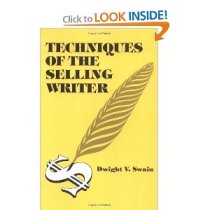
 When I was a very young and inexperienced writer, the best advice I got from published authors of my acquaintance was to pick up a copy of Dwight Swain’s book, TECHNIQUES OF THE SELLING WRITER. Yes, this book has been around that long. Actually, this book has been around longer than I have. Before I had a chance to snag a copy from my local bookseller, I received a copy from my Great-Aunt Gladys, who was also a bit of an angel, encouraging my literary aspirations from the time I was two-years-old.
I consumed the book. I devoured it. I internalized it. I made its advice part of my subconscious. I refer to it frequently. My ancient copy is bright yellow, which makes it easy to spot on a crowded bookshelf from far across the room.
The power of two sentences changed my life as a writer.
One of the most difficult tasks for novelists is to condense their story down to less two hundred words. When someone asks you what your story is about, the temptation is to give all the backstory, the world-building and the details you painstakingly created. Nobody wants that. They want to know what the story is about.
Swain said that the heart of your story contains five elements, which can be reduced to two sentences: one a statement, the other a question.
- Character
- Situation
- Objective
- Opponent
- Disaster
I’ve found that keeping this in mind when creating my own story summary helps immensely. When someone asks me what SOVRAN’S PAWN is about, I tell them –
When convicted traitor Bo Barron’s father is kidnapped, she has to go under cover on an interstellar cruise liner at a gambling tournament to steal plans for an illegal weapon that are being auctioned off to meet the ransom demand. An attempt on her life by a mysterious methane breather, and the timely intervention of a handsome Inner Circle agent leave Bo wondering whether there is a weapon at all and will she survive the cruise long enough to rescue her father?
That’s a seventy thousand word book condensed into eighty-two words.
- Character – Convicted traitor Bo Barron
- Situation – father is kidnapped
- Objective – (There is a dual objective here) Stealing the plans, but also recovering her father
- Opponent – Mysterious methane breather (stated) Kidnappers (implied)
- Disaster – getting herself killed, or losing her father
You know, if I were brutal about it, I could trim it even more.
Let’s take a story you’re probably more familiar with, like STAR WARS (ANH)
When Luke Skywalker learns he’s in possession of stolen plans, he joins forces with Jedi Knight Obi-Wan Kenobi to turn them over to the Rebellion. But can he rescue the princess and keep the plans out of the hands of Darth Vader, who is determined to destroy the Jedi and recover the plans no matter the cost?
Or this movie?
During WWII, American ex-pat Rick Blaine finds himself in possession of stolen letters of transit and no easy way to rid himself of them. When the Nazi occupying force, an underground leader, and Rick’s ex-girlfriend all conspire to recover the letters, who will get the letters and who will end up dead or in a concentration camp?
See? Easy-peasy, lemon-squeezy.
Pick a favorite book or movie…any story really, and try it! Let me know how it works for you!
 Gotta Name My Blog
I think I’m going to need to pick up a copy of this book! Great advice.
If you don’t own a copy, you need one. It’s a must-have for every writer.
I LOVE this book!
Pingback: Tell Me What You Want, What You Really, Really Want | Gotta Name My Blog
Apparently, I need to buy this book?
The idea sounds a little like the inverse of Randy Ingermanson’s “Snowflake Method.” I’ve been on Randy’s email list for a while (years). As a certified pantser, I yearn for the supposed greener pastures of plotting, outlining, and organizing my stories. That would make life so much easier, wouldn’t it? Wouldn’t it?!
In brief, the method goes like this:
1. Write a one-sentence summary of the novel (15 words or less).
2. Expand that into a one paragraph description.
3. Write one-page summary sheets for all major characters (this is one I fail at miserably on the front end of any book I write).
And on it goes. I tried a couple of times to do this – taking an idea I had for a story and trying to build it out using the snowflake method. I didn’t get far before my pantser brain kicked in and pulled me away from all that annoying organization.
Still, in the back of my writing mind, I could see the value.
Recently, I conceived of (what I believe is) a brilliant idea for a new fantasy series. I won’t go into the details here because, you know – internet – but suffice it to say I wanted to anchor this great idea before it flittered away like a beautiful butterfly. What to do?
It hit me then: Could I use the first few steps of the snowflake method to capture at least the bare bones of the story and some of the characters?
Then I had epiphany number two: I was already the (proud?) owner of something called “Scrivener.” A lot of writers know what Scrivener is – a devilishly clever piece of software that seems tailor made for plotters and makes a passing attempt to entice pantsers, too.
I bought the original version of Scrivener ages ago, fully intending to force myself to become a plotter. Yeah, that didn’t happen. But fast forward to now and I’d paid good money (again) to upgrade to the latest version of Scrivener for Windows… still intending to organize my writing brain, calm the chaos, and actually finish several books I’ve started.
What was epiphany number two? I already had Scrivener and it occurred to me that this software tool and the snowflake method go together like ham and eggs, peanut butter and jelly, rum and Coke… well, you get the idea.
And so, I spent a few hours capturing the new novel’s ideas and characters in Scrivener, fundamentally following Ingermanson’s method. I don’t have the new novel written yet, but the idea and the foundation I need to write it is saved for posterity – get this – in an ultra-organized way.
Now, I can go back to my gothic adventure novella and the three-book fantasy series I’ve been writing for decades. I will try my best to not think about this new series I’ve birthed. It’s safe and sound, waiting in Scrivener with all the detail I’ll need to pick it up and remember why it’s such a fantastic idea.
I should be able to focus on my other, more mature works in progress, right?
Right?
MD
Yes. Buy this book.
I don’t know much about the snowflake method, but from what you’ve described, the Swain model will help develop your ideas created with the snowflake method into full stories. Swain manages to break down the nuts and bolts of storycraft into terms my squirrel writer brain can follow.
And yes, it will help you develop other WIPs.